
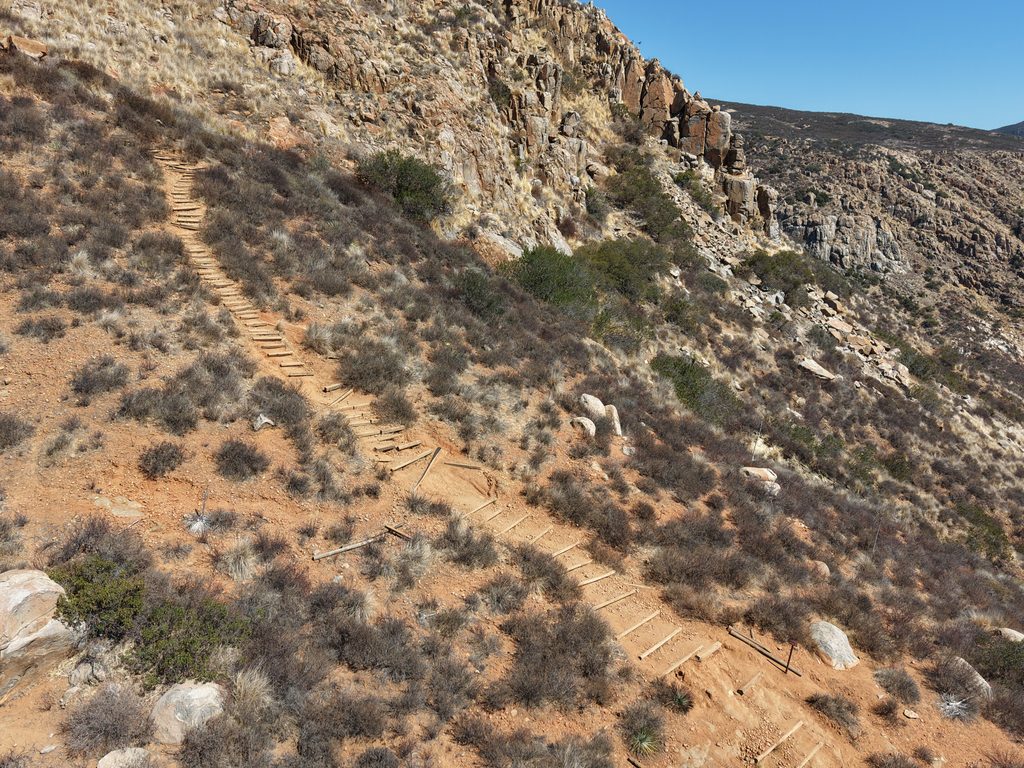
San Diego County residents will gain a safer, more durable route to Mission Trails’ South Fortuna peak while native habitat and the San Diego River watershed receive added protection through a newly approved $990,102 grant secured by the nonprofit Mission Trails Regional Park Foundation (MTRP Foundation). Mission Trails Regional Park is by the City of San Diego, while the MTRP Foundation has served as the City’s nonprofit partner at the park since 1988.
The San Diego River Conservancy Governing Board recently approved $990,102 in Proposition 4 Nature-Based Solutions funding for the Mission Trails Regional Park Foundation (MTRP Foundation), the nonprofit partner of the City of San Diego at Mission Trails Regional Park, to reconstruct the deteriorating South Fortuna Stairway, commonly known as the “Stairway to Heaven,” a fitting nickname for a grueling climb that rewards hikers with sweeping, “heavenly” views of Mission Gorge, the San Diego River and downtown San Diego. The San Diego River Conservancy is a California state agency that works to protect and enhance the San Diego River watershed through investments in public access, habitat restoration, water quality, climate resilience and other conservation projects across the region.
The project is expected to benefit the approximately 60,000 hikers who use the route each year, replacing unstable wooden steps with natural stone, improving drainage, reducing erosion and restoring habitat damaged as hikers have increasingly moved around deteriorated sections of the trail.
The grant also demonstrates the role nonprofit partners can play in helping local governments deliver improvements to public parks and facilities by securing state grant funding and expanding the resources available for major projects.
“This is exactly why the Mission Trails Regional Park Foundation exists,” said Jennifer Morrissey, executive director of the MTRP Foundation. “Mission Trails belongs to the people of San Diego, and our role as its nonprofit partner is to step up, find resources and help the City accomplish important projects that benefit the public. Nearly $1 million is now coming into a City-owned park because our Foundation pursued this opportunity, and the public will see the benefit every time they hike this trail.”
Under the project, the Foundation will hire a qualified trail contractor to reconstruct approximately 630 linear feet of stone steps along the existing South Fortuna Trail alignment, covering roughly 282 feet of elevation gain. The project does not create a new trail or reroute the existing one.
The City of San Diego Parks and Recreation Department will provide design review and collaborate with the MTRP Foundation on the project. The Foundation will manage implementation of the grant and contribute a $15,000 match.
“This investment will deliver real benefits for the people of San Diego and visitors alike,” said Julia Richards, executive officer of the San Diego River Conservancy. “Rebuilding the South Fortuna staircase will make a heavily used public trail safer and more sustainable, while reducing erosion, and protecting native habitat in the San Diego River watershed. It is the kind of project that improves public access to nature today while protecting these important natural resources for future generations.”
A renewed San Diego destination
The rebuilt South Fortuna staircase will do more than replace a deteriorating trail feature. It will create a more distinctive, memorable destination within Mission Trails, giving both San Diegans and visitors a safer way to make the climb to South Fortuna’s summit and take in one of the park’s most breathtaking views. The sweeping view from the top helps explain why generations of hikers have come to know the steep climb as the “Stairway to Heaven.”
The experience itself is part of the draw: a challenging climb through open space, a clear sense of accomplishment at the top and panoramic views across San Diego. With a durable stone staircase replacing the failing wooden steps, the route is an iconic Mission Trails experience that locals return to and visitors seek out. Hiking supports physical health through movement, endurance and cardiovascular activity, while spending time outdoors can also support mental health and well-being by giving people space to decompress, reset and connect with nature.
For a region where access to nature is one of San Diego’s defining assets, investing in places like Mission Trails means creating more no-cost opportunities for people to get outside, move their bodies and experience the landscape safely.
A heavily used trail showing its age
The South Fortuna staircase is the primary route to the summit of South Fortuna peak and connects hikers to Mission Trails’ broader network of approximately 60 miles of trails. Years of heavy use, extreme weather and erosion have badly degraded the wooden staircase. Some steps are unstable while others have shifted or disappeared altogether. As hikers navigate around those areas, repeated off-trail travel has widened portions of the corridor by an estimated 10 to 15 feet on both sides, damaging native vegetation and contributing additional erosion.
The reconstructed staircase is intended to guide visitors back onto the established trail footprint while improving footing and long-term durability. Project work will include removal of the existing wooden steps, installation of natural stone stairs, drainage improvements, new trail signage and restoration of disturbed areas along the trail margins. Construction and helicopter-supported material delivery will occur outside bird nesting season, with measures in place to reduce impacts to wildlife.
Benefits beyond the trail
The project also addresses issues downstream from South Fortuna. Stabilizing the trail and improving drainage are expected to reduce erosion and sediment entering the San Diego River watershed, while restoration work along the trail margins will support native coastal sage scrub and chaparral habitat.
The project is consistent with San Diego River Conservancy priorities supporting recreation, natural-resource protection and water quality. Funding comes through Proposition 4, the Safe Drinking Water, Wildfire Prevention, Drought Preparedness and Clean Air Bond Act of 2024.