
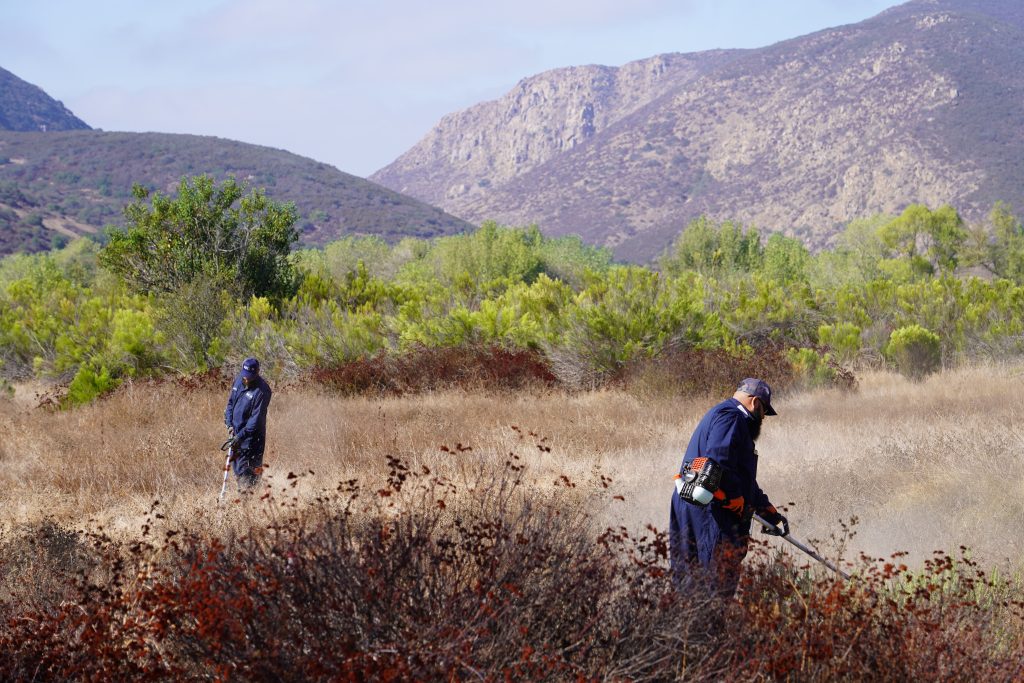
More than 60 tons of green waste have been removed from Mission Trails Regional Park as part of a major, multi-year effort led by the nonprofit Mission Trails Regional Park Foundation in partnership with the City of San Diego to reduce wildfire risk, restore native habitat and protect the San Diego River watershed and nearby communities.
Since September 2024, the Mission Trails Regional Park Foundation’s contractor, RECON Environmental, has carried out invasive vegetation management and habitat restoration work across approximately 756 acres of the park. Crews have removed 29, 40-yard containers of green waste totaling 62.02 tons, roughly the weight of 31 average passenger cars.
The work was made possible by a $1.8 million award from the San Diego River Conservancy and administered by the Mission Trails Regional Park Foundation, which works to preserve the park’s natural habitat and provide educational and recreational programs. The project is being carried out in close coordination with the City of San Diego and illustrates the critical role public-private partnerships can play in bringing additional funding, capacity and expertise to the care of public open space.
The grant runs through fall 2027. The agreement specifically calls for reducing the risk and intensity of fire by reducing flammable fuel loads through invasive, non-native plant removal while protecting native habitat and supporting the San Diego River watershed.
The milestone comes during National Preparedness Month, observed each September to encourage individuals, families and communities to prepare for emergencies and disasters. At Mission Trails, that preparation includes work happening across the landscape long before a wildfire starts.
“This is what reducing wildfire risk looks like before there is a fire,” said Jennifer Morrissey, executive director of the Mission Trails Regional Park Foundation. “It is people out here doing the steady, methodical work of reducing flammable fuels and the seed bank, removing invasive plants and caring for the landscape.
More than 750 acres is an incredible milestone, but just as important is the partnership behind it. The San Diego River Conservancy, a state agency, gave us the resources to take this work to another scale, and our partnership with the City allows us to put those resources to work where they can make a real difference.”
The Mission Trails project supplements, rather than replaces, the brush-management work the City of San Diego already performs in open spaces and wildland-urban-interface areas throughout the city. At Mission Trails, City rangers and crews already conduct vegetation and brush management, including work associated with designated Brush Management Zones.
“Mission Trails is one of San Diego’s most treasured open spaces, and generations of San Diegans have worked to preserve and protect it,” said Mayor Todd Gloria. “We have a responsibility to continue that stewardship, particularly as the threat of wildfire grows. This work will help reduce fire risk for nearby communities while restoring the native habitat and watershed that make Mission Trails so special. It’s a great example of what we can accomplish when the City, our nonprofit partners and the state work together to protect the places San Diegans love.”
The Conservancy-funded project adds substantial state resources and multi-year capacity, allowing crews to address larger areas, return to treatment sites as invasive vegetation regrows and carry out habitat-restoration work alongside fuel reduction.
When work began in fall 2024, one of the first major restoration efforts involved dethatching and removing years of accumulated dead, non-native vegetation from treatment areas throughout the park. In some places, that buildup had formed dense patches of dry, highly flammable biomass. Removing that layer helped reduce fuel loads, prepare the sites for continued invasive-species management and give native vegetation more room to recover.
Since then, crews have returned several times to remove invasive plants as they sprout back, catching them before they can go to seed and spread. Over time, that helps reduce the number of invasive seeds left in the soil and gives native plants a better chance to return.
“As Chair of the Mission Trails Regional Park Task Force and Vice Chair of the San Diego River Conservancy Board, fire and habitat are at the center of my work,” said Councilmember Raul Campillo, who represents San Diego City Council District 7, which encompasses Mission Trails Regional Park. “Protecting this valuable resource means thinking ahead. Fire moves through this terrain in minutes, not hours, so the work happens now, before the wind, before the spark.”
The work provides environmental benefits alongside reducing wildfire risk.
Invasive plants can crowd out native vegetation, diminish biodiversity along wildlife corridors and affect habitat surrounding the San Diego River. Their removal can help native plants recover, protect rare and endangered species, improve watershed health and support habitat for birds and other wildlife.
Restoration areas span a wide range of native habitats, including coastal sage scrub, chaparral, grassland, coast live oak woodland and riparian communities. As competition from invasive plants has been reduced, crews have observed natural reestablishment of native species in many treatment areas, allowing plants already present on site to begin regrowing.
The work also includes reducing competition from non-native vegetation around sensitive native species, including San Diego ambrosia (Ambrosia pumila) and Orcutt’s brodiaea (Brodiaea orcuttii), with the goal of supporting and expanding those populations within the park.
The Mission Trails project is part of a much broader San Diego River Conservancy effort to protect watersheds while reducing wildfire risk. For approximately 15 years, the Conservancy and its partners have implemented an invasive non-native plant control and restoration program that provides multiple benefits, including hazardous-fuel reduction, reduced fire and flood risk and native habitat restoration.
In recent years, the Conservancy has invested in wildfire-prevention projects throughout San Diego County, supporting fuel reduction, vegetation management, firebreaks, firefighting equipment and communications infrastructure in partnership with cities, fire agencies, tribal governments and conservation organizations.
Other Conservancy-supported projects near Mission Trails illustrate the same watershed-wide approach. In Navajo Canyon, hundreds of invasive palms were removed and native riparian vegetation replanted. In Ruffin Canyon, invasive palms were removed while native trees and understory plants were established. In Rueda Canyon, invasive palms and thousands of pounds of other invasive vegetation were removed to reduce fire risk near homes, followed by native planting.
“Protecting the San Diego River watershed means looking at the whole landscape,” said Julia Richards, executive officer of the San Diego River Conservancy.
“Projects like this can reduce wildfire risk, restore native habitat and protect water quality at the same time. Partnerships with organizations like the Mission Trails Regional Park Foundation put state funding to work where it can have lasting benefits for both people and the environment.”
The San Diego River Conservancy approved the Mission Trails grant in February 2024. Its 2025 work plan identifies the Mission Trails Regional Park Foundation project among a broader portfolio of wildfire-related investments throughout the region, including fuel-reduction work, firefighting equipment and hazardous-fuel treatment.
At Mission Trails specifically, the Conservancy’s investment allows the MTRP Foundation to substantially expand the scale and duration of vegetation management possible within the City-owned park.
That distinction is important. The City of San Diego conducts brush management across the city as part of its broader work to reduce wildfire risk in open spaces and areas where development meets natural vegetation. Mission Trails benefits from that ongoing City work, while the Foundation-led project brings an additional $1.8 million investment specifically to this landscape.
The timing takes on added significance as San Diego moves into fall, when wildfire risk tends to increase in the region due to dry vegetation and seasonal Santa Ana winds
National Preparedness Month also offers an opportunity to remind San Diegans that preparation happens at multiple levels. Residents can prepare their homes, families and evacuation plans, while land managers, public agencies and nonprofit partners work together to reduce risks across the landscapes surrounding communities.
“Preparedness is a community-wide effort,” said San Diego Fire-Rescue Deputy Fire Chief Dan Eddy. “This project to reduce hazardous fuels in Mission Trails is an excellent example of the impact partnerships can have on reducing our year-round fire risk and protecting surrounding communities. We can all make a difference and do our part to be ready – have a plan, create defensible space, harden your home, and make sure you and your loved ones have an emergency plan.”
Treatment methods in Mission Trails vary by location and include hand weeding, mechanical removal and clearing. The current project also includes continued monitoring, volunteer stewardship and follow-up work intended to help prevent invasive plants from becoming reestablished.
Major restoration areas have included Father Junipero Serra Trail, Climbers Loop Trail, Kumeyaay Lake Campground, Oak Canyon trails, Oak Grove Loop Trail, the Visitor Center and Visitor Center Loop Trail, the Grasslands, the base of Cowles Mountain and the San Diego River corridor.
One of the most visible restoration areas is near the Visitor Center, where invasive-species removal and native planting are being used to build on habitat already present and encourage a more diverse native plant community.
The breadth of those treatment areas is part of what makes the project significant. The work is not focused on a single trail or landscape type, but on interconnected habitats throughout Mission Trails.
The project continues through fall 2027, with additional vegetation treatment, monitoring and follow-up work planned.
“More than 60 tons of removal is something worth celebrating,” Morrissey said. “But this work is not finished when the equipment leaves. Healthy habitat and reduced wildfire risk both require long-term care. This is exactly why strong public-private partnerships matter. They allow us to bring more resources to Mission Trails and invest in the long-term health and safety of a place that belongs to all San Diegans.”